Spanning Set
Theory
Span: If φ ≠ S ⊆ V, then span of S is defined to be the collection of all linear combinations of elements of S and if S= φ, then span of S is defined to be {0}. It is denoted by L(S).
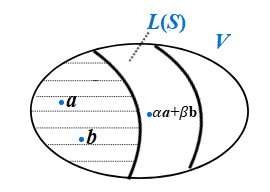
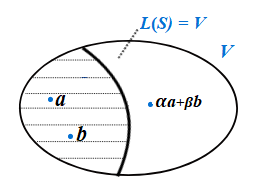
Spanning set: If L(S)=V, then S is called a spanning set of V and it is said that S spans V.
1. Example : Let R2 be the vector space over R, where S ⊆ R2. Then S={(1, 0)} does not span R2, i.e. L(S) ≠ R2.
Justification: By definition, L(S)={x(1, 0)| x∈R}={(x, 0)| x∈R}. We show that (1, 1) ∉ L(S) because if not, then (1, 1) ∈ L(S) which implies (1, 1)=α(x, 0)=(αx, 0) i.e. 1=0, a contradiction. Thus (1, 1) ∉ L(S). Hence L(S) ≠ R2. In the adjoining figure (Fig. 1) red line represents the span of S.
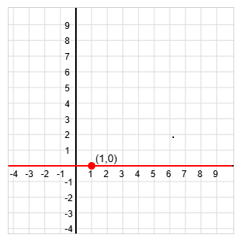
Fig. 1
Hands on Practice
S = { x } ⊆ R2
L(S)
Exercises
B: {(4, 3, 7), (1, 1, 1), (0, 0, 0)} spans R3